

What if a closer look at your scalp could help guide a cosmetic choice without explaining the cause of every change? It’s natural to want clarity before considering treatment, and to wonder what an assessment can realistically tell you. A scalp assessment before cosmetic treatment can provide useful observations, but it isn’t a medical diagnosis.
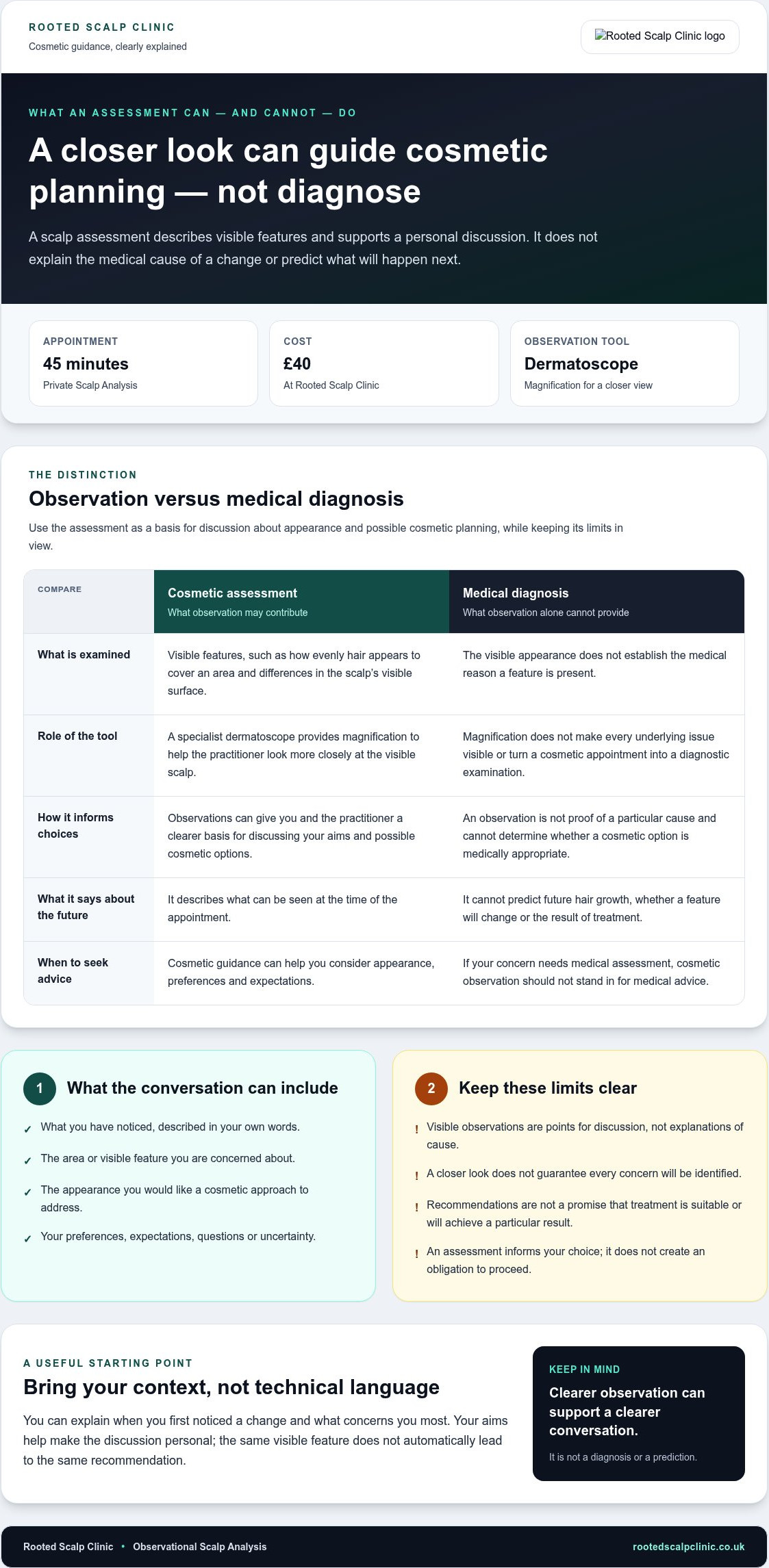
At Rooted Scalp Clinic, a private 45-minute Scalp Analysis uses a specialist dermatoscope to observe the scalp and inform personalised recommendations. It can help you discuss cosmetic options and scalp care with a clearer picture of what is visible. It can’t establish the medical cause of hair or scalp changes, predict an outcome or replace medical advice. The appointment costs £40.
This article explains what an observational assessment may contribute, where its limits lie and what personal context and questions can help you prepare. You’ll also find a clear distinction between cosmetic guidance and medical diagnosis, so you can consider your next step at your own pace.
Key Takeaways
- A scalp assessment before cosmetic treatment can inform planning and expectations, but it can’t determine the medical cause of hair or scalp changes.
- Treat observations made with a specialist dermatoscope as points for discussion, not predictions about future hair growth or treatment results.
- Note when you first noticed a change and what concerns you most to make your consultation more useful.
- Recognise when symptoms or changes call for medical advice rather than cosmetic guidance alone.
- Rooted Scalp Clinic’s private, 45-minute observational Scalp Analysis uses a specialist dermatoscope to inform personalised recommendations.
Why have a scalp assessment before cosmetic treatment?
Choosing a cosmetic approach is easier when you understand what can be observed, what you hope to change and what remains uncertain. A scalp assessment before cosmetic treatment offers an opportunity to discuss visible features and personal aims before deciding whether an aesthetic option is relevant to you.
A practitioner may notice differences in how hair covers an area or features of the scalp’s visible surface. These observations describe what is seen; they don’t explain why it is happening. For example, a difference in coverage may be relevant when discussing an aesthetic treatment, but observation alone can’t establish its medical cause.
An assessment informs cosmetic choices; it does not provide a medical diagnosis. The field of trichology concerns the study of hair and scalp. An observational cosmetic assessment has a narrower purpose: to support an informed discussion about appearance and possible cosmetic planning, not to replace medical advice.
What does a cosmetic scalp assessment help you understand?
A closer look can help describe visible details, such as how evenly hair appears to cover an area or whether the scalp’s surface looks different from one place to another. These are starting points for discussion, not findings that reveal a cause or predict future hair growth.
Your aims give those observations context. You might want to soften the appearance of a sparse-looking area or understand whether a cosmetic approach fits the effect you have in mind. Recommendations should reflect your features, preferences and expectations, rather than assume one option suits everyone.
Why discuss suitability before deciding?
An unhurried conversation lets you explain what matters most, raise questions and share any uncertainty. It can help separate the result you’re hoping for from what a cosmetic treatment can reasonably aim to change. You don’t need to arrive with a fixed decision; uncertainty is useful context, not a problem to solve quickly.
Suitability is part of thoughtful planning, not a promise that treatment will be appropriate or achieve a particular result. If your concern needs medical assessment, cosmetic observation shouldn’t stand in for it. Take time to consider the information and decide whether any next step feels right. An assessment is there to inform your choice, not create an obligation to proceed.
What can a scalp assessment observe before treatment?
A scalp assessment can offer a closer view of visible features that may be relevant to a cosmetic conversation. A specialist dermatoscope allows the practitioner to observe the scalp more closely than with the unaided eye. The aim is not to produce a definitive explanation, but to provide a clearer basis for discussing your goals and possible cosmetic options.
What is noticed depends on the individual. The conversation might cover how hair appears to cover an area, whether coverage looks more or less even in different places, or visible differences in the scalp’s surface. These are descriptive observations. On their own, they don’t establish why a feature is present, whether it will change or what may happen to hair in future.
How does a dermatoscope support observation?
A specialist dermatoscope provides magnification, helping the practitioner look more closely at the visible scalp. It supports observation; it doesn’t make every underlying issue visible or turn a cosmetic appointment into a diagnostic examination. The practitioner can explain what they see in straightforward terms and use those observations to inform personalised recommendations and discussion.
Think of the tool as a way to see detail, not as an answer machine. An observation may be useful to describe and discuss, but it isn’t proof of a particular cause or a prediction about treatment results. Keeping that distinction clear grounds the conversation in what can actually be seen.
How do observations connect with cosmetic goals?
Observations become relevant through your priorities. If your concern is the appearance of a particular area, the conversation can focus on what is visible there and the effect you’d like a cosmetic approach to have. Someone with a different concern or preference may need a different discussion, even if a visible feature seems similar.
This is why the same observation doesn’t automatically lead to the same recommendation. Your preferred look, comfort and expectations all matter. The practitioner can discuss whether a cosmetic option may be worth considering in light of what is observed and what you’ve shared, without implying that one approach is right for everyone.
Before a scalp assessment before cosmetic treatment, describe the change you’ve noticed in your own words and what you’d most like to understand. You don’t need technical language. For instance, saying that an area looks different when your hair is parted gives the conversation a useful starting point without assuming a cause.
- Observations describe visible features, not their medical explanation.
- Magnification supports a closer look, but doesn’t guarantee every concern will be identified.
- Your aesthetic aims help make the discussion relevant to you.
Rooted Scalp Clinic’s private observational Scalp Analysis uses a specialist dermatoscope to inform personalised recommendations. The value lies in a clearer conversation, with the limits of observation kept in view.
What a scalp assessment cannot tell you, and when medical advice matters
A close visual observation can describe what is visible, but it can’t explain the medical reason behind hair loss or scalp symptoms. A specialist dermatoscope doesn’t turn a cosmetic appointment into a medical investigation, and an assessment can’t confirm what may happen over time. Keeping that boundary clear helps you use the information appropriately.
A cosmetic scalp assessment can inform aesthetic choices, but it cannot diagnose the cause of hair or scalp changes. It also can’t guarantee that a treatment is suitable, that hair will regrow or that you’ll achieve a particular result. Recommendations are guidance for consideration, not a promise of an outcome.
Can an assessment diagnose hair loss or a scalp condition?
No. An observational assessment is not a diagnosis of hair loss or a scalp condition. It may describe visible features, but those observations alone can’t establish their cause. If you’re concerned that a change may have a health-related explanation, speak with a medical professional who can advise whether further investigation is appropriate.
This distinction is important, but it isn’t a reason to feel alarmed. Cosmetic guidance and medical assessment have different purposes. If a medical question is unresolved, address it separately rather than treating a cosmetic observation as an answer.
When should you pause cosmetic plans and seek medical advice?
Consider seeking appropriate medical advice if symptoms persist, worsen or change, or if you notice a sudden or unexplained change in your hair or scalp. For example, if discomfort continues or the appearance of an area changes unexpectedly, a cosmetic assessment can’t determine the cause. A GP or other appropriate medical professional can advise you about what to do next.
There’s no need to draw your own conclusions from a single observation. Note what has changed, when you first noticed it and whether it has continued, then share that context with a medical professional. If you’re unsure whether a concern is suitable for a cosmetic discussion, pause and seek medical advice first.
A scalp assessment before cosmetic treatment can still be useful once you understand its limits. It can inform a conversation about visible features and aesthetic preferences, but it cannot establish medical suitability or replace an assessment of symptoms. If medical advice is recommended, take that step before making a cosmetic decision, keeping the two questions distinct.
- Use cosmetic observations to discuss appearance, not to explain symptoms.
- Don’t treat recommendations as a guarantee of suitability or results.
- Seek medical advice for persistent, worsening, sudden or unexplained changes.
You can take your time. Clarifying a health concern first, or deciding not to proceed with a cosmetic option, is a valid next step. Clear boundaries help you make a considered choice with the right kind of guidance for your concern.
How to prepare for a scalp assessment before cosmetic treatment
A little preparation can help you focus the conversation on what matters. You don’t need technical terms or a theory about what is causing a change. A few notes about what you’ve noticed, what you’d like to understand and what you hope a cosmetic option might achieve are enough to get started.
Before your appointment, take a moment to:
- Write down when you first noticed the feature or change, and whether it has stayed similar or changed since.
- Describe what concerns you most in everyday language, such as the appearance of a particular area or how it looks when your hair is parted.
- Note the cosmetic result you’d like to explore, alongside any preferences or reservations that could affect your decision.
What details may be useful to bring?
Keep your notes simple and factual. Record the area you’d like to discuss, when it first caught your attention and what you’ve observed since. If your aim is to create a softer-looking impression or feel more at ease with a particular feature, describe that in your own words. There’s no need to label it or search for a medical explanation.
Your preferences are useful context too. You may have a particular look in mind, or simply want to understand what options could be discussed. Share only what feels comfortable; the conversation should respect your privacy and boundaries.
What questions help you make an informed decision?
Questions can keep the discussion focused on your priorities. You could ask:
- What can this assessment observe, and what can’t it establish?
- How do the observations relate to the cosmetic aim I’ve described?
- What is a suggested option intended to change in appearance?
- What can’t that option promise, including in relation to a particular result?
It’s also reasonable to ask about possible next steps and whether you can take time to consider them. You don’t have to decide during the conversation. If your concern involves persistent, worsening, sudden or unexplained symptoms, note that separately and seek appropriate medical advice. A cosmetic assessment can’t investigate their cause.
Preparation isn’t about finding the perfect answer before you arrive. It helps make sure your questions, comfort and aesthetic priorities have room in the conversation. To arrange a private, observational Scalp Analysis, book a Scalp Analysis and bring the questions that matter to you.
What happens after a Rooted Scalp Clinic assessment?
After a Scalp Analysis, you have observations and personalised recommendations to consider, not a diagnosis or an instruction to choose a treatment. Rooted Scalp Clinic’s private appointment lasts 45 minutes and uses a specialist dermatoscope to observe the scalp. It gives you space to discuss your concerns and relate what is observed to your aims for scalp or hair care.
The assessment is one-to-one. Recommendations follow an individual consultation, so the discussion can reflect what matters to you rather than assume the same approach suits everyone. You can ask for clarification, share what you feel comfortable sharing and take time to think about what you’ve discussed.
A private, observational Scalp Analysis
The appointment combines conversation with close visual observation. A specialist dermatoscope helps the practitioner look at the scalp, while your concerns and preferences give those observations context. The focus is on informing personalised recommendations, not diagnosing a medical cause. If your concern involves symptoms or a change that needs medical attention, an observational appointment shouldn’t take the place of medical advice.
There’s no need to treat the discussion as a commitment. Use it to understand what has been observed and how it may relate to your cosmetic goals, while remembering that no observation can guarantee suitability or a particular result.
Choosing your next step without pressure
A considered next step might be to reflect on whether the recommendations align with the appearance you’d like to explore, or simply to leave the conversation there for now. If you’re unsure, pause rather than rush. The decision to consider a cosmetic option remains yours.
Keep in mind what scalp analysis can contribute and where observation has limits. Those boundaries can help you weigh recommendations calmly and distinguish cosmetic guidance from medical investigation.
A scalp assessment before cosmetic treatment is most useful when it helps you understand the discussion without pressuring you to proceed. Take away the observations, consider your priorities and decide whether any possible next step feels right for you.
If a private, one-to-one conversation would help you explore your concerns, arrange a Scalp Analysis with Rooted Scalp Clinic. It’s an opportunity to discuss personalised recommendations at your own pace.
Take your next step at your own pace
You don’t need to turn uncertainty into an immediate decision. Consider what matters to you, what you’d like to understand and whether a cosmetic conversation feels timely. The value of a scalp assessment before cosmetic treatment can be helping you approach that choice with greater intention, not directing you towards a particular outcome.
A private Scalp Analysis offers space to discuss your questions and consider possible next steps without pressure. You can decide what you wish to share, ask for clarity and take time afterwards to reflect. Choosing to wait is also a valid choice.
Explore a private Scalp Analysis when it feels right for you. Let your comfort and confidence guide the pace.
Frequently Asked Questions
Can a scalp assessment diagnose the cause of hair loss?
No. Rooted Scalp Clinic’s Scalp Analysis is observational, not diagnostic. A specialist dermatoscope is used to examine visible features of the scalp, and the observations can inform personalised scalp and hair-care recommendations. They can’t identify or diagnose a medical cause of hair loss. If you’ve noticed a persistent or concerning change, seek appropriate medical advice rather than relying on a cosmetic assessment to explain it.
Is a scalp assessment necessary before cosmetic treatment?
Not universally; an assessment isn’t a medical prerequisite for every cosmetic choice. A scalp assessment before cosmetic treatment can help you explain what you’d like to change, hear what is visibly observed and decide whether a cosmetic discussion fits your aims. It can’t guarantee suitability or results, and having one doesn’t commit you to treatment. Use the conversation to clarify your options, then make an individual decision in your own time.
What happens during a scalp assessment before cosmetic treatment?
A private conversation gives you space to explain what you’d like to understand. The practitioner then observes your scalp using a specialist dermatoscope. The discussion informs personalised recommendations, but it isn’t a diagnostic test. You can bring questions and ask for clarification whenever you’re unsure.
Can a dermatoscope show why my scalp or hair has changed?
A dermatoscope can make visible scalp features easier to observe, but it can’t, by itself, explain why your hair or scalp has changed. The practitioner can describe what is seen and discuss whether it relates to the cosmetic effect you have in mind. If you need an explanation for a change, seek medical assessment; magnified observation isn’t a substitute and can’t forecast future hair growth.
What should I bring to a scalp assessment?
A short note can help keep the conversation focused. Include what you’ve noticed, roughly when it began and any changes since, then describe the appearance you’d like to discuss. You might also jot down questions about what the assessment can establish and what options may follow. There’s no need to arrive with a diagnosis or share anything you’d rather keep private.
What happens if the assessment suggests I need medical advice?
An observational assessment can’t diagnose a medical concern, so persistent, worsening, sudden or otherwise worrying symptoms are a reason to seek appropriate medical advice. You can pause any cosmetic decision while you clarify what support you need. There’s no need to assume what a change means, and a cosmetic service shouldn’t be relied on to address an underlying medical cause.

