

What if a fuller-looking scalp came from softening the contrast between scalp and hair, rather than changing the hair itself? That’s the idea behind scalp density shading: a cosmetic approach intended to create a subtle impression of greater visual density, not to treat hair loss or encourage regrowth.
If you’re considering scalp density shading, it helps to understand what the service aims to change, what it cannot do and how it differs from other scalp treatments. The appearance you can achieve depends on your individual scalp, hair and aims, so no particular result can be promised. At Rooted Scalp Clinic, density shading is a one-to-one cosmetic service, with appointments following an individual consultation. The clinic’s observational Scalp Analysis uses a specialist dermatoscope, but it is not a medical diagnosis.
This guide explains the intended visual effect, the limits of shading and how it differs from the clinic’s separate pigment-free treatment. It also covers when medical advice may be important, so you can weigh up the option with a clearer understanding and without pressure.
Key Takeaways
- Scalp density shading aims to soften the visual contrast between scalp and hair. It does not increase hair growth or physical coverage.
- A cosmetic change in appearance is different from medical hair-loss care. Sudden, unexplained or concerning changes call for appropriate medical advice.
- Before considering treatment, clarify the appearance you hope to achieve and the questions you want to discuss.
- Rooted Scalp Clinic provides AI Scalp™ · Density shading through an individual consultation and one-to-one appointment.
- The clinic also offers a separate AI Scalp™ pigment-free treatment. The two services should not be assumed to work in the same way.
What Is Scalp Density Shading, and What Does It Aim to Change?
When more scalp seems visible through the hair, it’s natural to look for a cosmetic option that could create a softer, more balanced appearance. The important distinction is that an aesthetic adjustment changes how the scalp and hair look together. It does not change the hair itself.
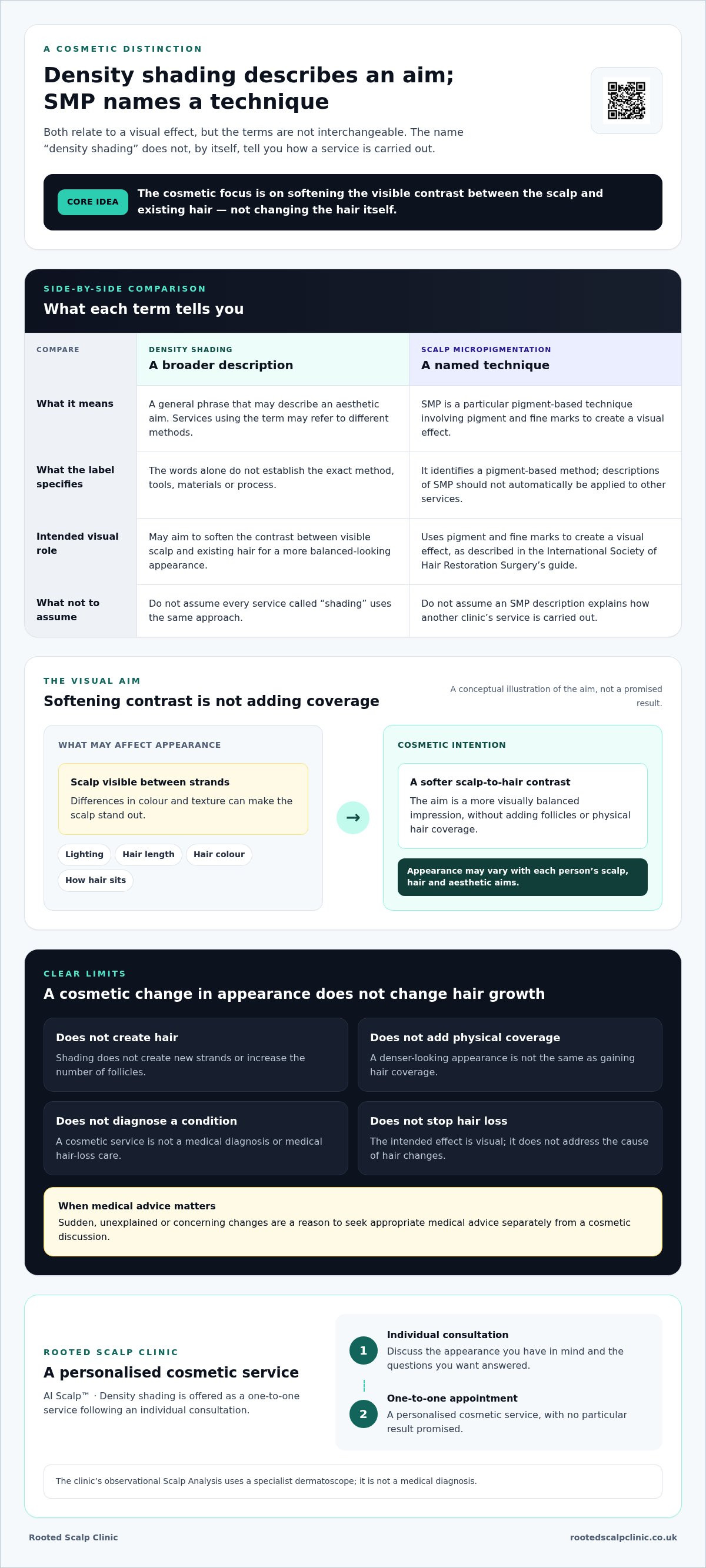
Scalp density shading is a cosmetic approach intended to reduce the visual contrast between the scalp and existing hair, creating the impression of a more balanced, denser-looking appearance.
That definition describes an aim, not a guaranteed result or a single standard procedure. The term is used broadly, and services may refer to different methods. Look beyond the label to understand what a particular service involves, rather than assuming that every treatment described as “shading” uses the same approach.
In a cosmetic context, the focus is appearance. Shading doesn’t create hair, increase the number of follicles, diagnose a scalp or hair condition, or stop hair loss. If you’re concerned about why your hair is changing, or the change is sudden or troubling, medical advice is separate from a cosmetic discussion.
How Is Density Shading Different from Scalp Micropigmentation?
Scalp micropigmentation, or SMP, is a named technique involving pigment and fine marks to create a visual effect. The International Society of Hair Restoration Surgery’s guide describes SMP in these terms. Density shading, by contrast, is a broader descriptive phrase. It may refer to an aesthetic aim without specifying the exact method.
The terms are not automatically interchangeable. SMP is a particular pigment-based technique, while “density shading” may be used more generally. The name alone doesn’t establish how a treatment is carried out, and general descriptions of SMP shouldn’t be taken as a description of every clinic’s approach.
What Does “Denser-Looking” Mean in a Cosmetic Context?
“Denser-looking” refers to how the scalp and hair appear in relation to one another. When more scalp is visible between strands, an aesthetic approach may aim to soften that contrast and create a more even impression. It doesn’t mean that new strands have grown or that the area has gained physical hair coverage.
A cosmetic change can alter the appearance of density, but it cannot change hair growth. How the effect may look depends on the individual’s scalp and hair, as well as their aesthetic aim. It is therefore more useful to discuss what “denser” means to you than to assume one definition will suit everyone.
How Scalp Density Shading Creates a Visual Effect
The intended effect is one of visual balance. Where hair looks less dense, more scalp may be visible between strands. Differences in colour and texture can make the scalp stand out, particularly from certain angles or in particular lighting. Shading is intended to address that appearance, not to alter the hair or scalp itself.
Scalp density shading aims to soften the visible contrast between the scalp and existing hair, so the area may appear more visually balanced without adding follicles or hair coverage. This describes the intended cosmetic effect, not a promised result. Appearance varies with each person’s scalp, hair and aesthetic aims.
Why Can Scalp-to-Hair Contrast Affect the Appearance of Density?
Think of a garden where patches of bare soil are easy to see between plants. The plants haven’t changed, but the visible gaps can influence how full the garden appears. In a similar, purely visual sense, visible scalp between hairs can affect the impression of coverage. This analogy is about what the eye notices; it doesn’t suggest that shading changes hair structure or the amount of hair present.
Lighting, hair length, colour and the way hair sits can also affect what someone sees. These are visual considerations, not a way to identify the cause of reduced density. The practical question is what appearance you hope to soften, and whether a cosmetic approach fits that aim.
Why Technique Descriptions Should Not Be Assumed to Apply to Every Service
Some sources describe scalp micropigmentation, or SMP, as a pigment-based method using fine marks to create a visual impression. The International Society of Hair Restoration Surgery explains this specific technique in its guide to scalp micropigmentation. It’s a useful reference for understanding SMP, but it shouldn’t be read as a universal specification for every service described as density shading.
Names can describe either a particular method or a broader cosmetic aim. A description of SMP doesn’t establish which tools, materials or process another service uses, and those details shouldn’t be inferred from the words “shading” or “density”. Rooted Scalp Clinic’s AI Scalp™ · Density shading is a personalised cosmetic service. A one-to-one appointment follows an individual consultation, so you can discuss the appearance you have in mind without assuming a particular technique.
Keeping this distinction clear helps set useful expectations: a visual adjustment may change how contrast is perceived, but it doesn’t increase follicle count, create hair or provide medical care. To explore the cosmetic aim in relation to your preferences, read more about Rooted Scalp Clinic’s density shading.
Scalp Density Shading: Realistic Possibilities and Clear Limits
A cosmetic option may support the appearance you’re hoping for, but its role has clear limits. Scalp density shading is intended to make a visual difference, not to change the underlying cause of thinning. Understanding that distinction helps you consider the service with realistic expectations.
Density shading can change how the scalp looks, but it cannot make hair grow or treat hair loss. Appearance and suitability vary from person to person, so no particular cosmetic result can be promised.
What Density Shading Cannot Do
Shading cannot create follicles, restore hair that has been lost, establish why thinning is happening or prevent future hair loss. It is aesthetic support, not medical diagnosis or hair-loss treatment. If your main concern is a change in your hair’s health or growth, a cosmetic appointment isn’t an answer to that concern.
Start by separating the outcome you want. If you’re seeking a visual adjustment, a cosmetic conversation can explore that aim. If you want an explanation or treatment for hair loss, that is a separate medical question.
When a Cosmetic Option Is Not a Substitute for Medical Advice
Sudden, unexplained or concerning changes are a reason to seek appropriate medical advice. An observational scalp assessment can describe what is seen, but it cannot diagnose a condition or determine its cause. Rooted Scalp Clinic’s Scalp Analysis uses a specialist dermatoscope for an observational assessment, not a medical diagnosis.
You don’t need to decide what a change means before seeking advice. Describe what you’ve noticed to an appropriate health professional, particularly if it is worrying you. Cosmetic assessment and medical advice have different purposes, and one doesn’t replace the other.
Before considering a cosmetic option, it may help to separate your questions:
- Appearance: What visual change are you hoping for?
- Expectations: Are you comfortable with an aesthetic adjustment that doesn’t add hair or address its cause?
- Health: Is there a new or concerning change that deserves medical advice?
These questions can make a discussion more useful without turning it into a pass-or-fail test. Take time to reflect. You’re not obliged to pursue a cosmetic treatment simply because you’re curious about it.
A measured approach leaves room for both clarity and choice. If your aim is cosmetic, an individual consultation can explore your preferences and the limits of the service. If your concern is medical, seek advice appropriate to that concern. Keeping those paths distinct helps you make a decision without relying on promises that shading cannot make.
How to Think Through Scalp Density Shading Before Exploring It
Curiosity doesn’t commit you to treatment. A little reflection can help you decide whether scalp density shading fits what you’re looking for, or whether you’d rather leave the idea there for now. There’s no universal ideal for how hair or a scalp should look. Your own preferences are the useful starting point.
You might find it helpful to work through these points in order:
- Name the appearance you’re hoping for. Describe what you notice and what “more balanced” would mean to you, in your own words.
- Keep the aim cosmetic. Consider whether you’re exploring a change in appearance, rather than expecting regrowth or a medical change.
- Bring your individual context into the conversation. Share what matters to you about your scalp, hair and comfort with a cosmetic option.
- Choose a next step, or none at all. Continue the discussion, take time to reflect or decide it isn’t right for you.
Clarify the Change You Are Hoping to See
It can be easier to describe a preference than to choose a technical term. You might say that an area feels more noticeable to you, or that you’d like to explore a softer visual balance. You don’t need to know what method would achieve that aim. Nor do you need to adopt someone else’s idea of a natural, fuller or more polished look.
Separate what you hope to see from what you hope might happen biologically. A cosmetic discussion can focus on appearance and comfort; it can’t promise new growth or explain why hair has changed. Being clear about the difference gives the conversation a grounded starting point.
Make Space for Questions About Scope and Expectations
A useful conversation can cover the purpose of the cosmetic service, your personal aims and any relevant context about your scalp. You should understand what is being considered and what falls outside its scope. Rooted Scalp Clinic’s observational Scalp Analysis uses a specialist dermatoscope to assess what can be seen; it is not a medical diagnosis.
If a change is sudden, unexplained or concerning, seek appropriate medical advice rather than relying on a cosmetic assessment to interpret it. These conversations have different purposes. Sharing relevant context can help keep expectations clear without asking a cosmetic appointment to answer a medical question.
It’s all right to pause. You might decide the idea is worth exploring, or that no treatment is the right choice for you. If an individual discussion would help you reflect on your preferences, explore a one-to-one density shading consultation with Rooted Scalp Clinic.
Exploring Density Shading with Rooted Scalp Clinic
Once you have a clearer sense of what you hope to change, learning about the service can help you decide whether it feels relevant. Rooted Scalp Clinic offers AI Scalp™ · Density shading as a cosmetic service. Its purpose is aesthetic, and the discussion centres on your aims rather than a promise of a particular result.
A Personalised, One-to-One Approach
Appointments are one-to-one and follow an individual consultation. This gives you space to talk about what you’ve noticed, the appearance you’d like to explore and any context that feels important. You don’t need technical language or a fixed decision. A straightforward description of what matters to you is a helpful place to begin.
The conversation can also help keep expectations clear. Density shading is considered as a cosmetic adjustment, not as a way to create hair, address the cause of hair loss or provide medical care. Your preferences and individual context matter, so the discussion is tailored rather than based on an assumption that one approach suits everyone.
When an observational view of the scalp is useful, Rooted Scalp Clinic’s Scalp Analysis uses a specialist dermatoscope. It is an observational assessment, not a medical diagnosis. It can inform a cosmetic discussion, but it does not establish the cause of a change or replace medical advice where that is needed.
A measured consultation leaves room for questions as well as answers. You can describe the look you have in mind, discuss what the cosmetic service is intended to address and consider whether its scope matches your expectations. Curiosity does not commit you to treatment.
For clarity on costs, AI Scalp™ · Density shading starts at £200 per session. The clinic also offers a prepaid three-session course for one-area density shading at £530.
A Gentle Next Step if You Would Like to Explore the Option
If you’re still weighing things up, a conversation can help you understand the cosmetic scope and explain what you hope to achieve. Take time to consider what you’ve heard and decide whether you’d like to continue exploring the service. Choosing not to proceed is a valid outcome too.
For an individual discussion of your preferences, explore scalp density shading at Rooted Scalp Clinic. You don’t need to have everything decided in advance; begin with what you’d like to understand.
Take the Next Step at Your Own Pace
Deciding whether scalp density shading feels right doesn’t need to happen all at once. Take time to notice what kind of visual change matters to you, or simply let the idea rest. A thoughtful choice can include deciding not to proceed.
If you’d like to explore further, Rooted Scalp Clinic offers a one-to-one setting to talk through your aims and understand the cosmetic scope. The conversation can begin with a question, not a commitment. Explore scalp density shading at Rooted Scalp Clinic and take the next step only if it feels right for you.
Frequently Asked Questions
Can scalp density shading cover a scar?
It may be considered for the appearance of a scar, but whether a cosmetic approach is appropriate depends on the scar and your individual circumstances. Examples involving scalp micropigmentation shouldn’t be taken as a promise that every shading service can cover a scar. If a scar is changing, uncomfortable or causing concern, seek suitable medical advice first. A cosmetic assessment can discuss appearance, but it isn’t a medical assessment of the scar.
Does scalp density shading involve tattooing?
Some scalp micropigmentation methods use pigment applied to the skin and are described as tattooing. The ISHRS guide to scalp micropigmentation explains that specific approach. However, “density shading” can describe a broader cosmetic aim, so the phrase alone doesn’t establish that every service uses the same method. Rooted Scalp Clinic provides AI Scalp™ · Density shading as a cosmetic service; general SMP details shouldn’t be assumed to describe it.
Can scalp density shading be combined with a hair transplant?
SMP is discussed in hair-transplant contexts, but that doesn’t establish that every density-shading service can be combined with surgery. If you’re considering a transplant, discuss whether cosmetic shading is relevant, along with any timing or suitability questions, with the medical professional responsible for your surgical care. They can consider your individual circumstances. Rooted Scalp Clinic provides cosmetic density shading, not hair transplantation or surgical care.
What should I do if my hair is thinning suddenly?
If you notice sudden or unexplained thinning, seek advice from an appropriate medical professional, such as your GP. A cosmetic treatment can’t establish why the change has happened or treat its cause, so it shouldn’t be used instead of clinical advice. Rooted Scalp Clinic’s scalp assessment is observational, using a specialist dermatoscope, rather than diagnostic. You don’t need to identify the cause yourself before seeking advice.
Can scalp density shading make hair grow back?
No. Scalp density shading is a cosmetic approach, not a way to produce hair growth or restore follicles. It also can’t determine why thinning is occurring. If your priority is addressing hair loss itself, speak with an appropriate medical professional about your concerns and possible next steps. Keeping the cosmetic aim separate from questions about growth can help you decide what kind of support you’re looking for.
Is scalp density shading permanent?
There isn’t one answer for every service: permanence depends on the specific method and individual factors. General information about scalp micropigmentation shouldn’t be taken as a duration claim for Rooted Scalp Clinic’s density shading. In a consultation, you can discuss the intended approach and realistic expectations for your circumstances. Avoid relying on a general label alone to assume how long a particular cosmetic service will last.
Can a scalp analysis diagnose the cause of hair thinning?
No. Rooted Scalp Clinic’s Scalp Analysis is an observational assessment using a specialist dermatoscope, not a medical diagnosis. It can support personalised scalp and hair-care recommendations, but it shouldn’t be treated as identifying or treating a medical cause of thinning. If you’ve noticed a new, sudden or concerning change, seek appropriate medical advice. The observational assessment and clinical advice serve different purposes.
