

What if a closer look at your scalp offered useful context without turning every change into a cause for concern? A scalp analysis can help you understand visible differences in your scalp and hair. It’s natural to wonder what those observations mean, and whether they amount to a medical diagnosis.
If you’ve noticed flaking, changes in oiliness or a difference in hair density, uncertainty can be unsettling. An assessment should feel calm and informative, not judgemental or like pressure to choose a treatment. Its value lies in careful observation and practical, personalised next steps.
At Rooted Scalp Clinic, a private, one-to-one Scalp Analysis appointment lasts 45 minutes and uses a specialist dermatoscope to observe scalp and hair characteristics. The findings can guide tailored scalp and hair-care recommendations, while remaining distinct from medical testing or diagnosis.
In this guide, you’ll learn what an assessment may involve, what its observations can and can’t tell you, and how they can shape a care approach. We’ll also explain when a concern sits beyond cosmetic guidance, so you can consider the next step with greater clarity.
Key Takeaways
- Learn which visible scalp and hair characteristics a scalp analysis can help you understand, without treating observations as proof of a cause.
- See how informal self-checks, cosmetic observation and medical assessment differ in purpose and scope.
- Use your original concern and the observations made to consider care guidance that feels relevant to you.
- Look for recommendations that relate clearly to what was observed, rather than a one-size-fits-all solution.
- Recognise when a concern may sit beyond cosmetic guidance and call for medical assessment.
What Is Scalp Analysis and Why Is It Helpful?
A scalp analysis is a structured observation of visible scalp and hair characteristics, such as how the skin looks and how hair is distributed. It offers a closer, more organised view than a quick glance in the mirror, helping you explore a concern or question you already have. The aim is understanding, not labelling.
A cosmetic scalp analysis describes visible scalp and hair features to inform personal care; it does not diagnose a medical condition or establish its cause. An observation is only one part of the picture. A change in appearance may have several possible explanations, and a visual assessment cannot confirm which one applies. For a general overview of how hair can be analysed for different purposes, see Hair analysis; laboratory analysis of hair is distinct from a cosmetic visual assessment.
You might seek an assessment because your scalp feels different, your hair seems less dense in a particular area, or you’re unsure whether to adjust your care routine. An assessment can put visible details into context and help shape considered recommendations around your observations and priorities, rather than assuming a condition or offering a one-size-fits-all answer.
What questions can a scalp analysis help explore?
An appointment can help explore practical questions: what visible features stand out, which areas would you like to understand more clearly, and what kind of scalp or hair-care guidance fits your routine? For example, if you’ve noticed dryness, you could discuss how your scalp appears and whether your current care habits suit your needs. Observation can inform that conversation, but it can’t prove what caused a feature or predict how it will change.
Useful recommendations should connect to what was observed and what matters to you. You might want a simpler routine, a clearer understanding of your scalp’s appearance or guidance about cosmetic options. Your priorities help give the observations practical meaning.
Who might find a private scalp assessment useful?
A private assessment may suit someone curious about a visible change, looking for a considered starting point, or simply wanting to understand their scalp and hair more clearly. The reason can be practical, cosmetic or exploratory. You don’t need to arrive with a particular concern or a desired outcome.
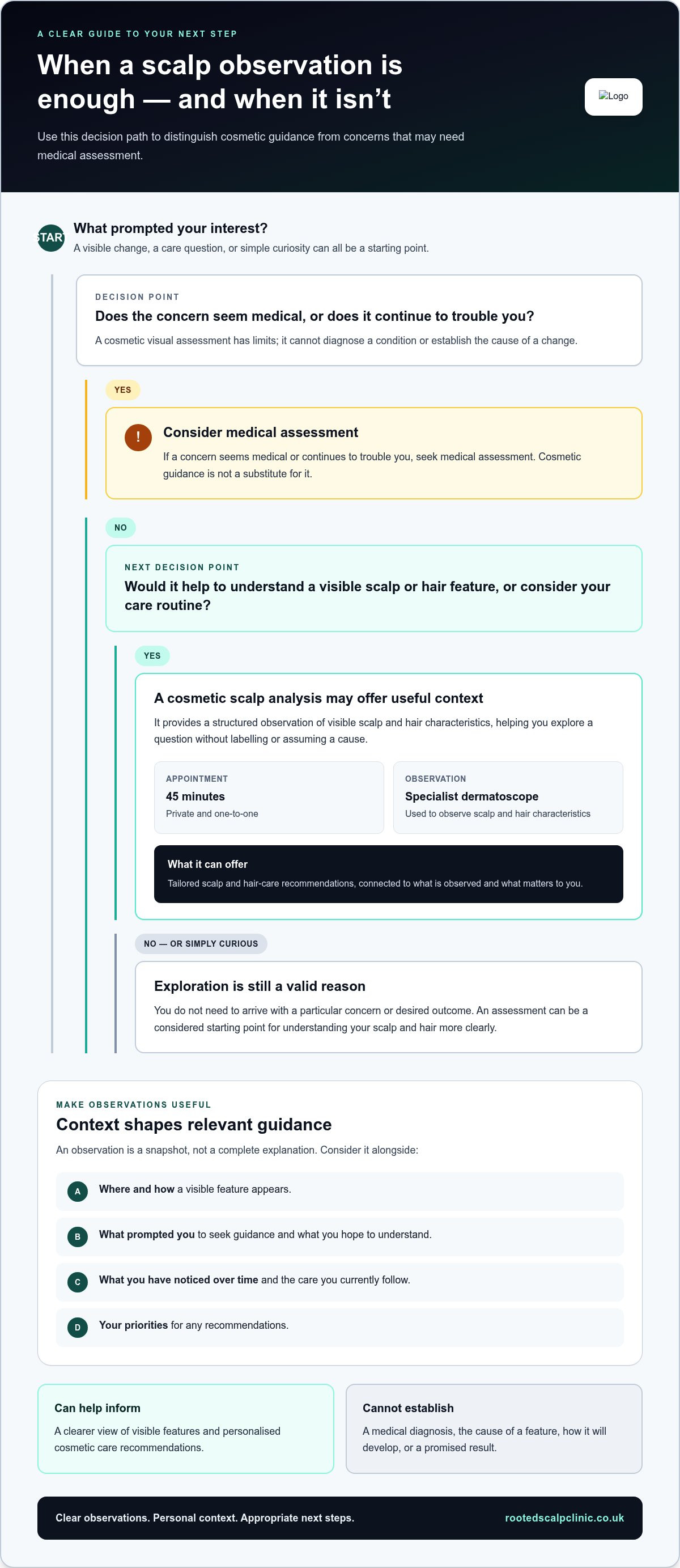
Taking an interest in your scalp doesn’t mean something is wrong, and a visible difference doesn’t have to define how you feel about your appearance. A calm, observational approach can help you decide what, if anything, you’d like to do next. If a concern seems medical or continues to trouble you, cosmetic guidance has limits and isn’t a substitute for medical assessment.
How Scalp Analysis Turns Observation Into Personalised Insight
An observation is a snapshot, not a complete explanation. What’s seen during an assessment can be considered alongside the reason you came, what you’ve noticed over time and the care you currently follow. This keeps the conversation anchored in your experience instead of turning one visible feature into an assumption about its cause.
An observation is most useful when considered alongside where and how a feature appears, your reason for seeking guidance, your existing care habits and the priorities you want recommendations to address. These details help shape relevant cosmetic guidance while leaving room for uncertainty. Personalised recommendations are suggestions to consider, not a promised result or medical treatment plan.
Context gives an observation practical meaning. A visible feature may be relevant to one person’s care question and less relevant to another’s. Explaining what prompted your interest and what you hope to understand helps keep recommendations connected to your priorities. It also helps distinguish what can be seen from what would require a different kind of assessment.
What kinds of visible features may be considered?
An assessment may look broadly at visible scalp and hair characteristics, such as how the scalp’s surface appears or how hair is distributed across an area. The focus isn’t a fixed checklist that assigns meaning to every detail. What’s relevant depends on your reason for attending. If you’re curious about a particular area, for example, the discussion can centre on what is visible there and what you’d like to understand about it.
This makes the process more personal than a score or a single label. The purpose is to describe what can be observed and consider whether it offers useful context for your care preferences. It doesn’t determine why a feature is present, how it will develop or what result a product or routine will achieve.
Why context matters when interpreting observations
The same visible characteristic may prompt different questions for different people. One person might want help thinking through a scalp-care routine; another may simply want a clearer view of an area they’ve been curious about. Your concern helps guide which observations matter and keeps recommendations proportionate to what you’re seeking.
It can help to explain what you’ve noticed, when it first caught your attention and what you hope to take away from the appointment. These details don’t prove a cause, but they can make the conversation more useful. If an observation doesn’t answer your broader question, that’s useful to recognise too. A careful discussion can clarify what visible features may inform and where the limits of cosmetic guidance begin.
If an individual discussion would help you make sense of what you’ve noticed, explore Rooted Scalp Clinic’s private scalp analysis as a starting point for personalised care guidance.
Scalp Analysis, Self-Checks and Medical Diagnosis: What Is the Difference?
Looking at your scalp in a mirror can help you notice a change, but some areas may be difficult to see clearly and it can be hard to judge what a feature means. A cosmetic assessment offers a more structured view and space to discuss care questions. Medical assessment has a different purpose: it investigates health concerns and may involve clinical judgement or tests. These approaches aren’t interchangeable.
Cosmetic scalp observation describes visible features and can inform care guidance; medical diagnosis assesses health and identifies a condition. Rooted Scalp Clinic’s assessment is observational and does not provide medical diagnosis. A close-up view, including one made with a specialist instrument, doesn’t by itself establish why hair loss or another change is happening. Seeing a feature is not the same as identifying its cause.
- Self-check: You notice what appears different to you, perhaps by parting your hair or looking in a mirror. This can help you describe a concern, but visibility and interpretation are limited.
- Cosmetic scalp analysis: A practitioner observes visible scalp and hair characteristics and discusses them in relation to your care interests. The purpose is greater awareness and personalised cosmetic guidance, not diagnosis.
- Medical assessment: A suitably qualified medical professional considers health concerns and determines whether further assessment or investigation is needed. A dermatologist is a medical doctor specialising in skin, including the scalp.
What a scalp analysis can reasonably contribute
A cosmetic assessment can help you describe what’s visible more clearly and consider which care recommendations may suit your observations and preferences. It may provide a more considered starting point than a quick self-check alone. The guidance should remain proportionate: it can support choices about personal scalp and hair care, but it isn’t a treatment plan for a medical condition or a promise of a particular result.
Use the conversation to clarify what was observed and how a suggestion relates to it. If the observation doesn’t answer your main question, that’s useful to recognise too. A responsible explanation makes clear what the assessment can offer and where its limits lie.
When a cosmetic assessment is not the right answer
If your concern is about your health, or you want to know why a change is occurring, seek suitable medical advice rather than relying on cosmetic observation. A GP can advise on appropriate next steps, and a dermatologist can assess skin and scalp concerns. This isn’t a conclusion about what your symptoms mean; it’s a way to have health questions considered in the right setting.
Keep the distinction simple: observation can help you understand what is visible and shape cosmetic care guidance; medical questions call for medical assessment. You don’t need to treat every change as a problem, but you can seek professional medical advice if you’re worried or would like a health concern properly assessed.
How to Use Scalp Analysis to Choose Your Next Step
An assessment can give you observations to consider, but you don’t need to turn them into an immediate decision. Start with the reason you sought guidance, understand what was actually observed, then decide whether any suggested care feels relevant. This keeps the focus on your needs rather than on acting on every detail or recommendation.
You can take the process in order:
- Revisit your original concern. What did you hope to understand, and is that still the question you want answered?
- Clarify the observations. Separate what was visibly noted from any interpretation or assumption about why it might be there.
- Consider the guidance. Decide whether a recommendation relates to your concern and fits the kind of cosmetic care you’re seeking.
If your question is mainly about personal care or appearance, cosmetic guidance may help you think through options. If it’s a health concern or you want to understand a possible medical cause, seek appropriate medical advice instead. An observational appointment isn’t a substitute for that assessment, and you don’t need to make a cosmetic decision before addressing a health question.
A simple way to reflect on assessment recommendations
For each suggestion, consider how it connects with what was observed and the concern that brought you in. Is it relevant to your priorities? Do you understand what it is intended to address, and do you feel comfortable considering it? You’re entitled to take time to reflect. Recommendations are personal guidance, not a universal checklist everyone needs to follow.
For example, if you wanted clarity about one visible area, consider whether a suggested care step relates to that area and your stated aim. If the link isn’t clear, ask for the reasoning to be explained. You can also decide that no change feels right for you at present. A useful recommendation should help you make an informed choice, not leave you feeling obliged to proceed.
Keeping expectations realistic after an assessment
A scalp analysis offers a view of observable characteristics at the time of the appointment. It can support understanding and inform cosmetic care choices, but it can’t promise that a feature will change or establish progress towards a particular outcome. Treat the observations as context for a decision, not proof of what will happen next. Your comfort with any proposed step matters.
There’s no need to rush. You might choose to reflect, seek medical advice about a health concern or simply continue with your current approach. Each can be a valid next step, depending on the question you’re trying to answer. If a private, one-to-one assessment would help you consider your observations and care options, book a Scalp Analysis appointment with Rooted Scalp Clinic.
Rooted Scalp Clinic’s Private, One-to-One Scalp Analysis
For a more considered view of your scalp and hair, Rooted Scalp Clinic offers a private, one-to-one Scalp Analysis appointment. It’s a space to discuss what you’ve noticed and receive observational guidance, without pressure to pursue a particular cosmetic option. Bring a specific question or simply come with a wish to understand your visible scalp and hair characteristics more clearly.
A specialist dermatoscope supports the observational assessment. The appointment lasts 45 minutes and costs £40, with time for the assessment and personalised scalp and hair-care recommendations. These are shaped by what can be observed and by the concerns you bring, rather than being a universal routine. The appointment can help you consider relevant care guidance, but it doesn’t establish a medical cause or promise a particular result.
A considered assessment, centred on the individual
The private, one-to-one setting allows the conversation to centre on your priorities. Explain what prompted your interest, share what you hope to understand and ask questions as you go. Observations made with the dermatoscope inform tailored recommendations, while the focus stays on visible characteristics and personal care guidance.
There’s room to reflect. You’re not expected to arrive with a diagnosis, a fixed plan or a decision about what to do afterwards. If a recommendation is made, consider how it relates to your observations and whether it feels appropriate for you.
Explore Scalp Analysis at Rooted Scalp Clinic
An assessment is an opportunity to understand, not a commitment to treatment. It provides cosmetic, observational guidance and doesn’t replace medical assessment or diagnose a scalp or hair condition. If your concern is medical, seek advice from an appropriate medical professional. Keeping that distinction clear helps you choose the right kind of support for your question.
If you’re looking for a calm starting point, Explore Scalp Analysis and decide whether a private appointment feels right for you. You don’t need to have every question settled in advance. A clear understanding of the appointment’s purpose and limits can help you make your choice at your own pace.
Choose a Next Step That Feels Right for You
You don’t need a perfect explanation for what you’ve noticed before seeking clarity. Sometimes the useful next step is simply deciding what you’d like to understand better and what kind of guidance would feel comfortable. That intention can keep any conversation focused on your needs, rather than pressure to change something.
A scalp analysis may be one way to explore visible features and consider cosmetic care. Take time to decide whether that kind of observation suits your question. If your concern is medical, prioritise appropriate medical advice; if you’re exploring personal care, let your own preferences shape what you do next.
If a discreet, individual assessment feels like a helpful starting point, explore Scalp Analysis at Rooted Scalp Clinic. Book a private, 45-minute appointment for £40 to discuss your observations and receive personalised scalp and hair-care recommendations.
Frequently Asked Questions
Is scalp analysis suitable for different hair types?
Yes, a scalp analysis can be considered for different hair types; the useful focus depends on your reason for attending and the features you’d like to discuss. There isn’t one hair type that serves as the standard. For example, you might want to understand how a particular area looks in the context of your own hair. If your main concern is a health symptom, seek appropriate medical advice rather than relying on cosmetic observation alone.
Can I have a scalp analysis if I have recently coloured or styled my hair?
Yes, you can mention recent colouring or styling when discussing what you’ve noticed. It may be useful context for considering visible features, but the assessment is a view of what can be observed at that appointment, not a test that identifies every influence on scalp or hair appearance. Share details you feel are relevant, such as a recent change in your routine, and keep the purpose focused on personal cosmetic guidance.
How often should I repeat a scalp analysis?
There’s no set interval that suits everyone, and you don’t need to repeat an assessment simply because time has passed. Consider whether your questions, observations or care priorities have changed since your last appointment. If they haven’t, you may not have a reason to book another cosmetic assessment. It isn’t medical monitoring, so discuss any health-related follow-up with an appropriate healthcare professional.
Does scalp analysis hurt?
Scalp analysis is an observational appointment, not a treatment. The specialist dermatoscope is used to view the scalp, rather than to carry out a procedure. If you’re unsure what to expect or feel uncomfortable at any point, say so during the appointment; the private, one-to-one setting gives you space to raise concerns. If you have a particular sensitivity you’d like considered, mention it as part of the conversation.
How long does a scalp analysis appointment take?
Rooted Scalp Clinic’s Scalp Analysis appointment lasts 45 minutes and costs £40. You can use the time to discuss what prompted your visit and consider the observations and care recommendations in relation to your priorities. Allow yourself a little time afterwards to reflect on any guidance rather than feeling you need to make an immediate decision. The appointment is observational, so it shouldn’t be treated as a medical diagnosis or a promise of a particular cosmetic result.
Can scalp analysis tell me exactly why my hair is thinning?
No. Rooted Scalp Clinic’s assessment can help you consider visible scalp and hair characteristics, but it can’t establish the medical cause of thinning. A close-up view alone doesn’t confirm why a change is happening. If thinning is concerning you, or you have another health question, speak to an appropriate healthcare professional for medical advice. Cosmetic recommendations from an observational appointment aren’t a substitute for diagnosis or hair-loss treatment.
